


Project: Nanjing Yangtze River Bridge
Nanjing Yangtze River Bridge Project – Jiangsu, China
China’s first double-deck road-rail bridge, symbolizing national engineering achievement and strategic connectivity, with HiTens tools ensuring structural integrity in critical bolting applications.
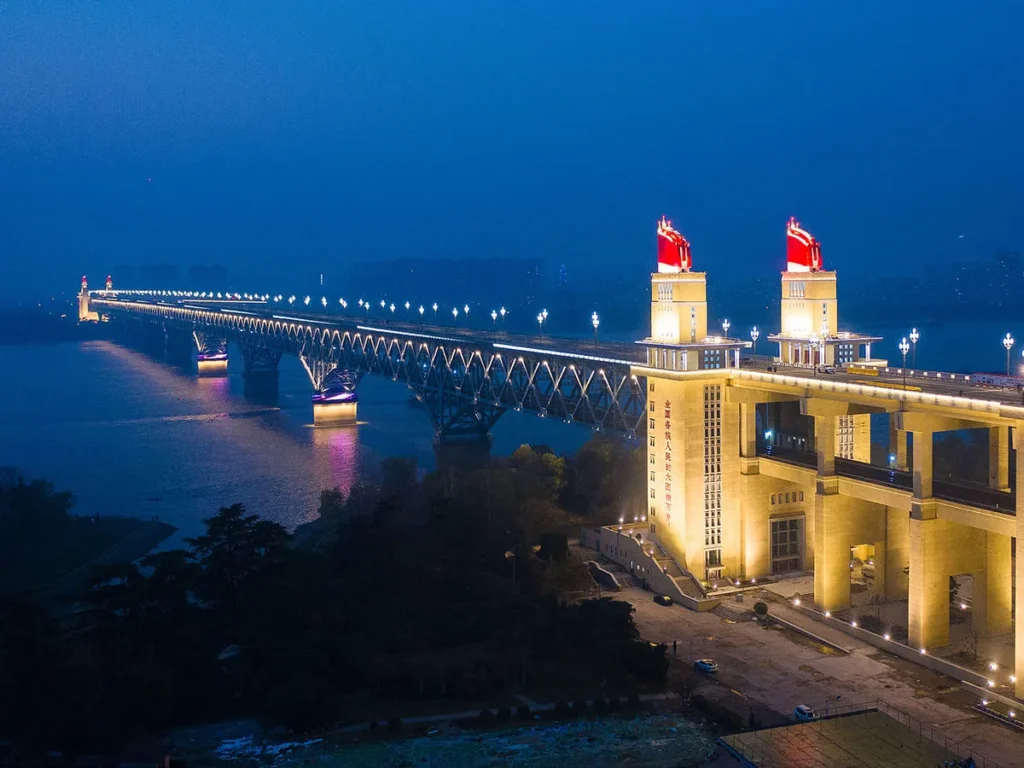
Project Overview
The Nanjing Yangtze River Bridge is China’s first self-designed double-deck bridge, spanning the Yangtze River between Gulou and Pukou Districts in Nanjing. The upper deck carries a 4-lane road, while the lower deck supports a double-track railway, forming a vital north-south transportation artery and enabling uninterrupted rail connectivity from Beijing to Shanghai.
Completed using steel truss construction with cantilever assembly and deep foundations, the bridge allows safe passage for vessels up to 5,000 tons. HiTens wrenches were employed extensively to ensure precise, high-strength bolting across main trusses and tower structures, guaranteeing structural reliability and construction efficiency.
Project Overview
The Nanjing Yangtze River Bridge is China’s first self-designed double-deck bridge, spanning the Yangtze River between Gulou and Pukou Districts in Nanjing. The upper deck carries a 4-lane road, while the lower deck supports a double-track railway, forming a vital north-south transportation artery and enabling uninterrupted rail connectivity from Beijing to Shanghai.
Completed using steel truss construction with cantilever assembly and deep foundations, the bridge allows safe passage for vessels up to 5,000 tons. HiTens wrenches were employed extensively to ensure precise, high-strength bolting across main trusses and tower structures, guaranteeing structural reliability and construction efficiency.
Engineering Significance
As the third Yangtze River crossing in China after the Wuhan Yangtze River Bridge and Chongqing Baisha River Bridge, the Nanjing Bridge is the largest of the three. It enabled direct rail connectivity from Beijing to Shanghai without interruption from the Yangtze River, cementing its role as a landmark in China’s railway and bridge history.
The bridge’s main superstructure consists of steel truss beams, with 9 piers supporting 10 spans (1×128 m + 9×160 m). The main truss uses parallel chord diamond-shaped trusses with stiffening rods, erected using cantilever assembly methods. The piers’ foundations are embedded 33–47 meters below the riverbed, utilizing a combination of:
Mass concrete caissons
Steel caissons with pipe piles
Floating reinforced concrete caissons
Sheet-pile cofferdam pile foundations
The main truss beams, with nine 160-meter spans, were assembled on-site using high-grade alloy steel components, with riveted connections ensuring precision load transfer and long-term durability.
Design Parameters
Railway alignment: The northern approach connects from Lin Chang Station, reaching Nanjing Station on the southern bank.
Railway deck: Double-track, 14 meters wide, with continuous welded rails, gradient 4‰, minimum curve radius 1,200 m.
Road deck: 15 meters wide, 4 lanes, maximum slope 3.17‰, minimum curve radius 250 m.
Bridge total length: Railway 6,772 m, road 4,588 m, main river span 1,576 m.
Load capacity: Railway rated C24, roadway rated H18.
Approach structures: Southern bank features a branching road bridge (Huilong Bridge), 409 meters long, enabling access to ground-level traffic.
The bridge includes fortress-style bridgehead buildings at both ends, each 97.6 meters long, featuring 10-story towers with triple-flag motifs atop, reaching 70.4 meters high, with observation decks, elevators, and public halls, blending functionality with architectural aesthetics.
Structural Features
Main bridge trusses: Cantilever-assembled steel trusses, combining rigidity and flexibility to resist river currents, wind, and seismic forces.
Approach bridges: Long pre-stressed reinforced concrete beams, accommodating variable soil conditions on both banks.
Foundations: Combination of caissons, steel pipe piles, and cofferdam techniques, tailored to riverbed depth and composition.
Bridgehead towers: H-shaped reinforced concrete structures, supporting both roadway and railway loads.
HiTens’ Role in the Project
HiTens played a crucial role in ensuring precise bolting and structural integrity throughout the Nanjing Yangtze River Bridge:
Main truss assembly:
HiTens high-precision torque wrenches ensured consistent bolt tension across all spans, critical for maintaining truss geometry and load-bearing capacity.
Bridgehead construction:
Bolting of tower steel frameworks and reinforced concrete anchorage points relied on HiTens tools for accurate torque application, ensuring safety under dynamic loading.
Maintenance and inspection:
HiTens torque calibration solutions allowed ongoing inspection of high-stress connections, safeguarding bridge operation for rail and road users.
By providing reliable fastening solutions, HiTens contributed to the successful completion of a landmark bridge, which remains symbolic of China’s engineering independence and national pride.
Operational Impact
The Nanjing Yangtze River Bridge significantly enhanced regional and national connectivity:
Seamless rail travel: Direct train service from Beijing to Shanghai, without interruption by the Yangtze River.
Road access: Critical link between Nanjing’s northern and southern urban districts, integrating with major highways.
Maritime navigation: Supports vessels up to 5,000 tons, maintaining strategic shipping routes along the Yangtze.
Public and cultural significance: Beyond transportation, the bridge serves as a national landmark, integrating observation platforms and visitor facilities.
Economic and Social Benefits
Trade facilitation: Enhanced movement of goods along the Jinpu and Huning rail corridors.
Urban development: Strengthened Nanjing’s north-south connectivity, supporting urban expansion and commerce.
Tourism and cultural heritage: Bridgehead towers provide cultural and sightseeing spaces, preserving historical and symbolic significance.
Engineering milestone: Represents a technological breakthrough in bridge and railway construction, demonstrating the effectiveness of innovative assembly, precision bolting, and high-quality materials.
HiTens Impact Summary
HiTens tools ensured that all high-strength bolted connections met design tolerances, supporting:
Safe cantilever truss assembly
Bridgehead tower stability under multi-level loads
Long-term operational reliability for both rail and road decks
Through the application of precision fastening technology, HiTens played a critical supporting role in delivering China’s first self-designed double-deck bridge, a cornerstone in both engineering achievement and national development.
Learn more from our FAQ
Learn how HiTens supports construction and industrial projects worldwide with reliable shear and torque wrenches, precision calibration, and professional support.
What industries does HiTens serve?
HiTens supply all kinds shear wrench, electric torque controlled wrench, from M12 to M36, from metric to inch standard, and solution for construction bolt installation.
What makes HiTens wrenches reliable?
Every HiTens wrench is engineered for precision, strength, and durability. They are designed to ensure consistent torque stability and ease of operation, even in the most demanding environments.
Does HiTens offer customized wrench solutions?
Yes. We can design and manufacture custom shear wrenches and torque wrenches tailored to your specific project requirements and standards.
How does HiTens ensure product quality?
Our wrenches are manufactured under strict quality control protocols that meet both national and industry standards. We are also fully certified under the GJB9001B-2009 Quality Management System.
What kind of after-sales support does HiTens provide?
We offer comprehensive technical support—from product selection and calibration to on-site troubleshooting—helping our customers minimize downtime and maximize efficiency.